


🌎🏛️ Webinar: Breaking down the midterms
Join us Friday at 11am ET to explore what the midterms mean for power, data centers, and climate tech, live
Happy Monday!
The biggest permitting overhaul in decades just cleared its first Senate hurdle. It’s down to the wire, and with help from our webinar panel, we break down what’s in BAAJA, who’s fighting it, and why its backers say it’s now or never.
In deals, $80m for nuclear fuel recycling in Rhode Island; $74m for in-space sunlight reflectors in California; and $55m for fiber-optic sensing for subsea grid monitoring in Amsterdam.
In other news, COP31 pledges pile up in Antalya, next-gen nuclear has a FOAK-y week, and offshore wind lands a £12bn close.
Thanks for reading!
Not a subscriber yet?
📩 Submit deals and announcements for the newsletter at [email protected].
💼 Find or share roles on our job board here.
CTVC is powered by Currence, market intelligence to power the AI era.
Less than a week after the blue wave, the Senate gave a green light to the biggest permitting overhaul in decades, the Bipartisan American Affordability and Jobs Act (BAAJA). A final vote could come this week, and then it has to survive the House before the 119th Congress ends in January.
BAAJA came up, of course, at our webinar last week, The Midterms Changed Everything, so with help from our panel from Boundary Stone Partners, Crux, and Advanced Energy United, here’s what’s in it, who’s fighting it, and why now.
With a 73-25 procedural vote, senators moved the bill to the floor. BAAJA would:
Developers have long been asking for permitting reform. Over 70% ranked it first in a Crux survey, and the runner-up “wasn’t even close,” Crux’s Tim Fox said at our webinar. Today developers plan around the process. In another Crux analysis, over 80% of solar and wind developers said they avoid sites that trigger federal review.
The transmission section goes after the other big holdup. The median project now waits more than five years from interconnection request to commercial operation, partly because there aren’t enough wires to carry its power.
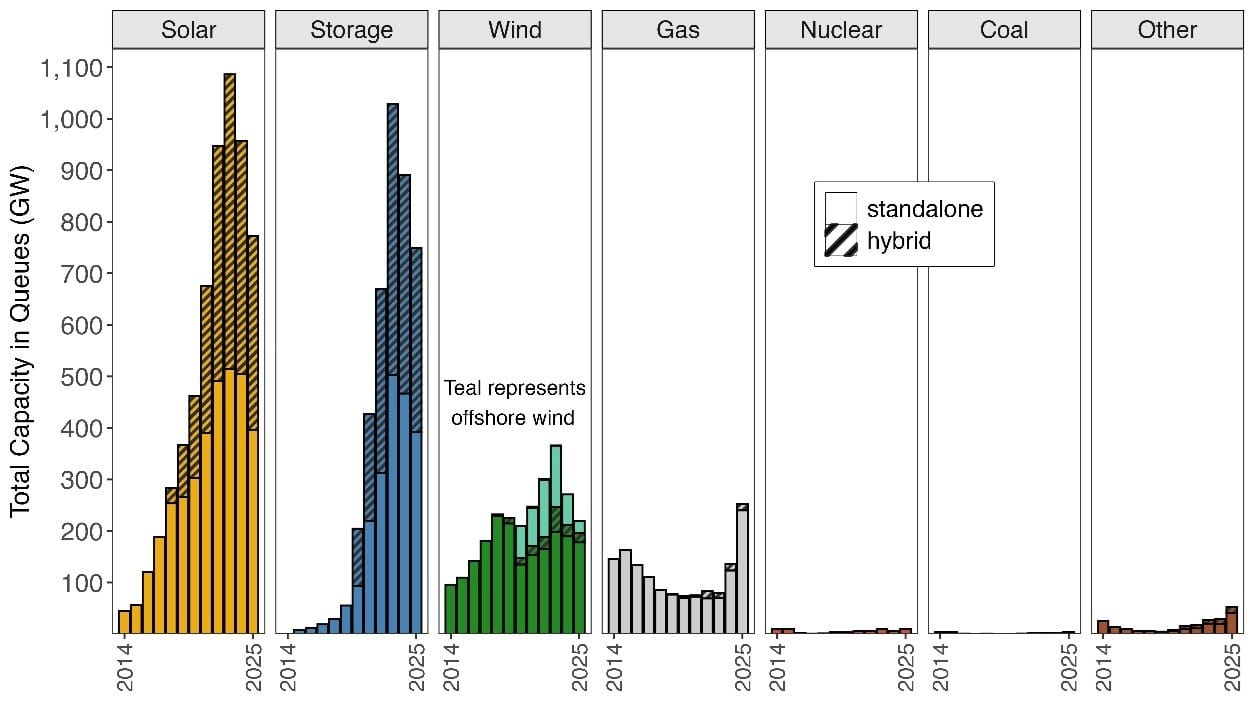
Source: Lawrence Berkeley National Laboratory and GridTracker
However, critics, from Earthjustice to the Center for Western Priorities, warn the certainty provisions would lock in two years of Trump-era approvals for drilling, mining, and pipelines. Trump hasn’t helped, he backed the bill last week, but said he’d still block wind.
Still, the climate math comes out positive. The Rhodium Group finds BAAJA cuts US emissions by up to 148m metric tons a year by 2040 and trims household power bills by $50 to $78 a year. But its model leaves out the certainty provisions, which critics are most worried about.
Now, the lame-duck bill has to waddle through the House before the new Congress takes over in January. “Congressional terms are 24 months, not 22,” Advanced Energy United’s Dylan Reed reminded our webinar audience.
A massive thank you to James Prussing of Boundary Stone Partners, Tim Fox of Crux, and Dylan Reed of Advanced Energy United for speaking at our webinar. Missed it? Catch the recording here.
⚡ Project Omega, a Newport, RI-based developer of nuclear fuel recycling technology, raised $80m in Series A funding from B Capital Group, 645 Ventures, Decisive Point, Essential Capital, MANTIS Venture Capital, noa, and other investors.
🛰️ Reflect Orbital, a Hawthorne, CA-based developer of in-space sunlight reflectors, raised $74m in Series A funding from Buckley Ventures, Convective Capital, Lux Capital, Salesforce Ventures, Sequoia Capital, and other investors.
⚡ Optics11, an Amsterdam, Netherlands-based developer of fiber-optic sensing technology for subsea and high-voltage grid monitoring, raised $55m in Series A funding from FORWARD.one, Join Capital, SET Ventures, and Value Creation Capital (VCC).
🔋 Coreshell, a San Leandro, CA-based silicon-anode battery technology developer, raised $30m in Series B funding from Access Industries, Ferroglobe, ADS Capital, Entrada Ventures, Helios Climate Ventures, and other investors.
⚡ Intergrid, a Helsinki, Finland-based autonomous industrial energy management software provider, raised $23m in Seed funding from Kvanted, Tesi, First Fellow Partners, Lifeline Ventures, and True Ventures.
⚡ Atomarine, a Boston, MA-based floating offshore nuclear-powered data center developer, raised $19m in Seed funding from Y Combinator, Audacious Ventures, Liquid 2 Ventures, Pantera Capital, Seven Seven Six, and other investors.
⚡ GreenJoules, a Pune, India-based developer of biofuels from agricultural and industrial waste, raised $16m in Series B funding from Amazon Climate Pledge Fund, Amazon Smbhav Venture Fund, Rainmatter Capital, and Singularity AMC.
🧾 TriPica, a Paris, France-based provider of cloud CRM and billing software for energy suppliers and telecom operators, raised $13.8m in Seed funding from Tilt Capital Partners.
📦 PORT, a London, UK-based developer of autonomous urban logistics and operator of e-mobility hubs for last-mile delivery, raised $8m in Seed funding from European Bank for Reconstruction and Development (EBRD) and Balnord.
🛰 Marble Imaging, a Bremen, Germany-based developer of high-resolution Earth observation satellites, raised $7m in Seed funding from Cherry Ventures.
🐄 Lucidome Bio, a Auckland, New Zealand-based developer of a livestock methane reduction vaccine, raised $5m in Seed funding from Ag Emissions Centre, AgriZeroNZ, Bezos Earth Fund, and Meat & Livestock Australia.
🌾 Aimer Farming, a Hamilton, New Zealand-based AI-powered pasture management platform, raised $2m in Seed funding from Pacific Channel, Cultivate Ventures, Agnition Ventures, Erbacher Food Family, Antipodean Capital, and other investors.
⚡ Calibrant Energy, a Tampa, FL-based provider of on-site distributed energy solutions, raised $72m in PF Debt funding from Investec, Citigroup, Liberty Bank, and Siemens Financial Services.
⚡ Delorean Corporation, a West Perth, Australia-based developer of waste-to-energy and bioenergy infrastructure, raised $14m in Post-IPO-Debt funding from Westpac and $6m in Post-IPO-Debt funding from Tanarra Restructuring Partners.
⚡ GreenJoules, a Pune, India-based developer of biofuels from agricultural and industrial waste, raised $11m in Debt funding from Technology Development Board (Government of India).
📦 PORT, a London, UK-based developer of autonomous urban logistics and operator of e-mobility hubs for last-mile delivery, raised $8m in Debt funding from European Bank for Reconstruction and Development (EBRD) and Balnord.
⚡ Intergrid, a Helsinki, Finland-based autonomous industrial energy management software provider, raised $1.5m in Debt funding from Finnvera.
⚡ IntelliSmart Infrastructure, a Gurgaon, India-based smart metering and digital solutions provider for power distribution utilities, was acquired by Adani Energy Solutions at a valuation of $324m.
🔋 RelyEZ Energy Storage, a Shenzhen, China-based developer of integrated energy storage systems, went public via IPO, raising $71.8m.
🌾 Just Climate, a London, UK-based climate investment firm, closed $540m Natural Climate Solutions I, backing growth-stage nature-based businesses that decarbonize agriculture across the land-use value chain.
This is a sample of deals available for Currence clients. Can’t get enough deals?
🌍 COP31 is underway in Antalya, with pledges aplenty. At least 14 countries endorsed the pledge to increase electricity’s share of final global energy use from around 23% today to 35% by 2035. Brazil presented its voluntary roadmap away from fossil fuels. China unveiled a new initiative to advance global cooperation on “high-quality” carbon credits. The EU signed the Global Geothermal Ambition 2050, to grow global geothermal supply 12x by 2050. Still, the first week of negotiations ended deadlocked over fossil fuels.
☢️ In next-gen nuclear news, the US NRC issued X-energy a construction permit for four Xe-100s at Dow’s Seadrift site. In Canada, OPG said its BWRX-300 at Darlington will miss both its October 2030 target and its C$7.7bn budget, citing incomplete first-of-a-kind engineering. In China, CNNC poured first concrete for Xuwei Unit 3, a 660MW second-of-a-kind (SOAK).
Building concurrently promises faster scaling, but sequencing drastically reduces cost risk. China ran its Shidaowan FOAK for years before starting Xuwei. In contrast, X-energy is betting on concurrency, appointing Fluor for its second site (Cascade) while Long Mott is still in licensing. But the FOAK risk is still universal, as OPG Darlington shows.
⚡ Bloom Energy and California Resources signed an MOU to assess at least 1GW of solid oxide fuel cell projects in California, using the high-concentration CO2 exhaust and CRC’s storage acreage for grid-connected and on-site customers.
Bloom’s shares are up roughly 217% in twelve months on a data center ledger that includes AEP’s 1GW+ order, and its Brookfield partnership expanded fivefold to $25bn in July.
🏗 Sublime Systems told a federal court the government has not produced a single document in its $87m grant lawsuit, filing a joint status report saying DOE refuses to meet over discovery in its suit over the May 2025 cancellations.
🌬 RWE and KKR reached financial close on the 2.8GW Vanguard offshore wind farm in a £12bn deal, while Tokyo Gas withdrew from the Ibaraki offshore wind project amid rising costs.
📊 Tapestry published field notes on deploying HyperQ, its AI review tool, in PJM’s first reformed interconnection cycle, which drew 811 projects totaling 220GW. This is the automation BAAJA would make standard.
🏗️ Meta signed a multi-year deal for environmental attribute certificates from Stegra’s 740MW hydrogen-based green steel plant in Sweden, which is still under construction, making it the third hyperscaler after Microsoft and Google to pay for green steel.
🚗 Global EV sales passed 2m in October, up 8% year over year, with North America posting its first annual growth.
💡2027 Wilkes Climate Innovation Prize: Open to global for-profits and nonprofits at any stage, pre-seed through public. Win the $250,000 grand prize and gain access to Wilkes Center events and networking. Apply by Nov 20.
💡Awesome Foundation Microgrant: Small grant of $1000 for individuals or small teams with innovative environmental projects close to implementation. Apply by Nov 27.
💡SET Award 2027: Apply for equity free €10,000 prizes per category for energy and climate startups. Finalists pitch in Berlin at the SET Tech Festival in March 2027. Apply by Nov 30.
💡Hello Tomorrow Challenge: Global deeptech competition with a €200K grand prize and prizes for track winners. Includes climate/energy-relevant tracks. Apply by Nov 30.
Account Executive @Currence
Data Product Manager @Currence
Founding Customer Success Manager @Currence
Senior Backend Engineer (AI) @Currence
Director of Growth & Giving @Elemental Impact
📩 Feel free to send us deals, announcements, or anything else at [email protected]. Have a great week ahead!
Join us Friday at 11am ET to explore what the midterms mean for power, data centers, and climate tech, live
What the midterm results mean for climate tech and data centers
11 climate SPACs in 2026, and what the 2021 class tells us about them

 Newsletter