


The world's biggest battery marker signs the biggest ever deal for Na-ion
Happy Monday!
This week, we’ve got a deep dive into CATL’s sodium-ion bet - a strong signal from the world's largest battery maker that the emerging battery tech is ready for the mainstream.
In deals, $935m for decentralized solar and energy efficiency, $117m for AI infrastructure with renewable energy development, and $59m for organic flow batteries.
In other news, the UAE’s OPEC-xit and impact on clean fuels, IPOs from X-energy and Fervo, and Meta gets into space-based solar.
Thanks for reading!
Not a subscriber yet?
📩 Submit deals and announcements for the newsletter at [email protected].
💼 Find or share roles on our job board here.
CTVC is powered by Sightline Climate, the tactical market intelligence platform for energy and investment decision-makers.

For years, sodium-ion batteries have been almost ready to compete with lithium-ion. This week, with lithium carbonate prices up over 2x since November, the world's largest battery maker said: Na, it's time.
CATL signed a 60GWh sodium-ion supply agreement with major Chinese energy storage integrator HyperStrong - the biggest sodium-ion order ever placed, by a wide margin. Spread over three years, that's roughly 20 GWh per year, the output of an entire battery megafactory running at full throttle.
The agreement covers technology R&D, product application, and project implementation. It builds on a broader framework signed in November 2025 in which HyperStrong committed to 200GWh of CATL cells through 2035. CATL's new statement says it has now "overcome the challenges of the entire sodium-ion battery mass production chain."
Sodium-ion batteries promise a lot on paper. The specs are strong: 160 Wh/kg, 15,000+ cycles, and the ability to discharge in 2-4 hours. Comparable to LFP, not a long-duration play, but well-suited for the daily cycling grid-scale storage demands. The inputs are cheaper and more abundant too, with sodium roughly 1,000x more plentiful in the Earth's crust than lithium. The cells run reliably across a wider temperature range than most lithium chemistries, and without the thermal runaway risk that makes grid-scale lithium deployments expensive to engineer around.
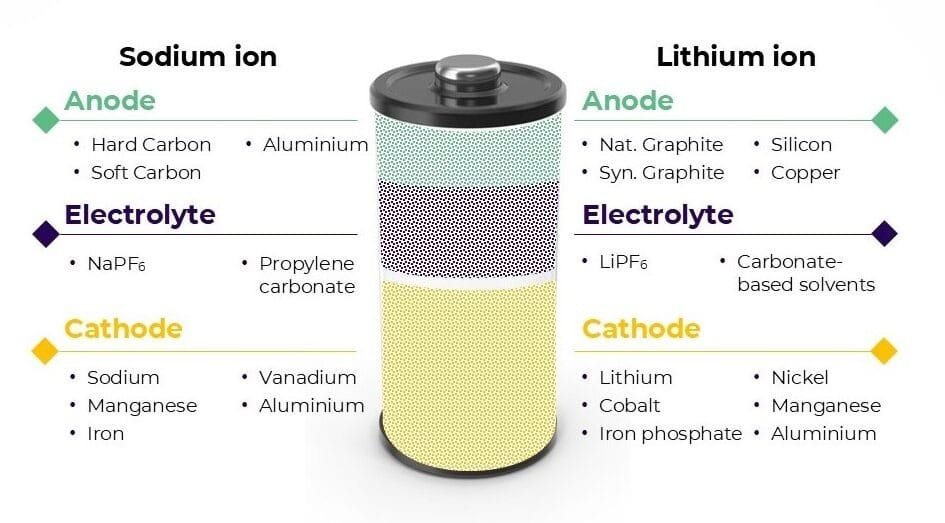
So what’s taken so long? The catch has always been its energy density, lower than lithium-ion’s, which inflates per-kWh costs until scale kicks in. With lithium prices at rock bottom through much of the early 2020s, manufacturers had little reason to make the switch. CATL's been trying to address both problems: design sodium-ion cells to the same form factor as its lithium-ion products, so existing supply chains and installation infrastructure need minimal adaptation, and wait for lithium prices to move. Now, they have.
For context, CATL shipped around 75GWh of energy storage batteries in all of 2025. At 20GWh/yr, this deal alone could represent about a third of that, in a technology that barely existed commercially twelve months ago.
The deal value hasn't been disclosed, but sodium-ion cells are currently running around $70-110/kWh at commercial scale – still a premium to LFP's ~$50/kWh – which pencils this deal in the low billions. That matters because a billion-dollar commitment from credible players is what triggers a cost curve. China has done this before, too, on solar and LFP. Manufacturing scale moves faster there than anywhere else. And if CATL doubles down on sodium-ion, retooling LFP lines in addition to building a few dedicated sodium-ion factories, costs could come down, fast.
60GWh headline is more of a ceiling than a forecast. The full volume likely only ships if lithium prices spike enough to make sodium-ion broadly competitive. More likely, a fraction goes to the markets where sodium-ion already wins: bitter cold, extreme heat, and safety-sensitive grid deployments. It could be a huge step for sodium-ion without putting a dent in the market for LFP.
The bigger signal is production capacity. Does CATL start retooling lithium-ion factories for sodium-ion, or does this remain a handful of dedicated lines alongside a massive continuing lithium buildout? The answer to that question is what separates a commercial milestone from an industry shift.
China brings tech from 0-1, rather than 1-10. For decades, the pattern in clean energy was straightforward: the US or Europe invented things, China scaled them. This seems to invert that. Now, the manufacturing breakthroughs, the first mass-production chain, and the first major commercial deal are all of it is coming out of China first.

🏠 Verda, a Helsinki, Finland-based AI cloud-renewable energy infrastructure provider, raised $117m in Series B funding from Lifeline Ventures, byFounders, Tesi, and Varma.
🔋 CMBlu Energy, an Alzenau, Germany-based organic flow battery developer, raised $59m in Series C funding from Samsung Ventures and STRABAG
🛵 Forest, a London, England-based shared e-bike operator, raised $36m in Series B funding from B8 Venture Partners, Fen Ventures, güil Mobility Ventures, and OKAI.
⚒️ Disa Technologies, a Casper, WY-based critical mineral processor, raised $33m in Series A funding from Galvanize Climate Solutions, BHP Ventures, Constellation Energy, Evōk Innovations and others.
🏗 All3, a Zug, Switzerland-based automated building design and construction platform, raised $25m in Seed funding from RTP Global,Begin Capital, s16vc, SuperSeed, and VNV Global.
♻️ ROSI, a Seyssins, France-based photovoltaic module recycling company, raised $23m in Series B funding from CMA CGM, European Innovation Council (EIC), Finadvice, Global 3T (G3T), and InnoEnergy.
⚡ ROCSYS, a Rijswijk, Netherlands-based robotics EV charging company, raised $13m in Series A funding from Capricorn Partners, FORWARD.one, Graduate Ventures, SEB Greentech Venture Capital, and Scania Invest.
🌱 Clarasight, a Queens, NY-based AI corporate travel platform, raised $12m in Series A funding from AlleyCorp, Clocktower Ventures, Future Back Ventures, Pulse Fund, Rackhouse, and other investors.
🔋 Tavion, a Stockholm, Sweden-based utility-scale battery storage developer, raised $8.2m in Pre-seed funding from BackingMinds, Course Corrected VC, and Emad Zand.
⚡ GreenYellow, a Puteaux, France-based decentralized solar and energy efficiency platform, raised $935m in Debt funding from Allianz Global Investors (AllianzGI), BNP Paribas, BPCE Energeco, Bpifrance and others.
🏭 TotalEnergies, a Paris, France-based integrated energy producer, raised $450m in PF Debt funding from China Construction Bank, DEG, Development Bank of Kazakhstan, European Bank for Reconstruction and Development (EBRD), Proparco and others.
⚡ Matrix Renewables, a Madrid, Spain-based renewable energy platform, raised $330m in PF Debt funding from Canadian Imperial Bank of Commerce (CIBC), MUFG Bank, and NatWest.
⚡ Nexamp, a Boston, MA-based renewable energy assets developer, raised $200m in Debt funding from Nuveen Energy Infrastructure Credit (Nuveen EIC).
⚡ Iberdrola México, a Mexico City, Mexico-based renewable energy generator and supplier, was acquired by Cox at an implied valuation of $4bn.
⚡ X-energy, a Rockville, MD-based advanced nuclear reactor and fuel technology company, announced an IPO at $1bn on Nasdaq under ticker XE.
🏠 Strategic Thermal Labs, a Georgetown, TX-based high-efficiency data center liquid cooling company, was acquired by Vertiv for an undisclosed amount.
🔋 Green Energy Storage Initiative (GESI), a Pullach, Germany-based large-scale battery energy storage developer, was acquired by Allianz Global Investors (AllianzGI) for an undisclosed amount.
☀️ Arena Renewables, a Scottsdale, AZ-based distributed solar and storage developer, was acquired by Headwater Energy for an undisclosed amount.
⚡ Thresh Power, a San Francisco, CA-based AI-powered energy project finance company, was acquired by Euclid for an undisclosed amount.
This is a sample of deals available for Sightline clients. Can’t get enough deals?

🛢️ The UAE announced it will leave OPEC on May 1, the biggest blow to the cartel in decades. Abu Dhabi exits after six decades to pursue "accelerated" production, freeing roughly 1 million barrels/day of spare capacity and stripping OPEC of its third-largest producer. [Link, Link]
In the short-term, the price impact on oil could be muted, but this puts long-run downward pressure on oil prices, and if other producers follow, the cartel's pricing power collapses further. Cheap oil is generally bad for clean energy and clean fuel economics, but the uncertainty cuts both ways: anyone financing infrastructure over a 3-5 year horizon now has to plan around oil price volatility, insurance risk, and potential supply gluts.
🔔 The climate tech IPO window is cracking open: X-energy debuted this week, with the Amazon-backed SMR developer popping 27% to close at an $11.5bn valuation. Fervo filed its S-1 to become the first EGS geothermal company ever to go public, pricing around $3bn. [Link, Link]
X-energy is priced on AI power demand enthusiasm, Fervo on actual projects. The number to watch is Cape Station: Fervo's Utah flagship is supposed to hit 100MW by early 2027, and how it performs will determine whether geothermal gets the same investor appetite nuclear has. Both companies going public in the same window is good for the sector regardless.
📋 Carbon credit registries Isometric and Verra are expanding into environmental attribute credits, bringing in corporate demand signals for industrial decarb. [Link]
EACs work like RECs — tradeable certificates that verify clean energy or low-carbon attributes. The new market layer helps companies that want to buy low-carbon goods like SAF or low-carbon cement but can't physically access them in their supply chain, so they buy the attributed emissions savings instead. That brings corporate demand signals to sectors where the purchasing mechanism didn't previously exist. It won't help DAC though, which needs decade-long offtake certainty to get built.
☀️ Meta signed deals for space-based solar and made capacity reservations with Noon for its ultra-long duration storage capacity, adding to a growing list of exotic power plays from hyperscalers. [Link, Link]
For early-stage vendors, landing a Meta capacity reservation is a big deal, but Meta is also hedging its bets. These reservations buy optionality on technologies that might matter in 5-10 years at relatively low cost. The more interesting signal will be when it arrives at the actual merchant contract.
The Trump administration struck another offshore wind exit deal, paying Ocean Winds to walk away from two US leases. Bluepoint Wind (NJ/NY) and Golden State Wind (CA) will be canceled in exchange for $885m in pledged fossil fuel investments, following the TotalEnergies precedent. The part-owner BlackRock's GIP will redirect $765m to an LNG facility. [Link]
⚖️ A group of House Republicans introduced a bill to restore IRA renewable energy tax credits, pushing back against their own party's reconciliation package which would gut them. [Link]
🌞 Chinese solar exports doubled to a record 68GW in March as the Iran war energy crisis drives global demand for alternatives. [Link]
🚗 Autonomous vehicles can now get tickets in SF. [Link]

📅 SOSV VC–Founder Physical AI Matchup: Free and virtual starting May 11, this matchmaking event connects Physical AI investors with startups up to Series B. Physical AI covers AI applied to real-world systems that can sense, decide, and act — think robotics, autonomous systems, and beyond. Register to get 1:1 introductions and explore partnerships in the space.
📅 ClimaTech After Dark: Join at Boston Climate Week on May 5, 5–7pm. Tickets are $25 and bring together students, young professionals, and early-career folks for a live DJ set, mentorship conversations, and an on-site resume drop with climate employers.
💡 Founders Connect: Apply to attend this founder-first event on May 14 in London. Plus, British Land is launching a new lab space there and tours will be available on the day. Open to founders, startup leadership, and engineers for free.
📅 Trellis Impact 26: From Jun 23-25 in Moscone West, San Francisco, Trellis Impact brings together 3,500+ leaders powering the future of sustainable business, from AI-enabled solutions to emerging technologies reshaping decarbonization, energy, circularity, and beyond. Get practical insights and hard-won examples of the technologies and strategies that are influencing sustainable business transformation. Register by May 15 before prices go up, and you can get 20% off with our partner code: TI26SCP
📅 Electric Innovation Awards: Apply by June 3 for the 2026 Electric Innovation Awards, which spotlight scalable electrification projects across transportation, buildings, manufacturing, and grid modernization.

Marketing Lead, @Glimpse
Strategic Finance Engagement Lead, @Planetary Scale
Senior Consultant, Financial Communications, ESG Advisory Practice, @FTI Consulting
Capital Markets Manager or Associate, @Origis Energy

📩 Feel free to send us deals, announcements, or anything else at [email protected]. Have a great week ahead!
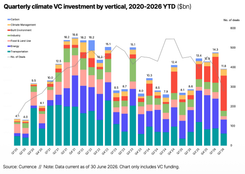
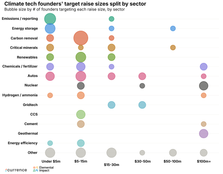
CTVC and Elemental Impact surveyed 100+ founders. This is what they said

 Newsletter