


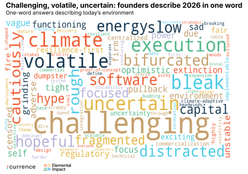
🌍 2026 Founder Survey by CTVC and Elemental Impact!
We asked 100+ climate tech founders how they're raising in 2026. Here's what they said.
On the ground at Yotta, the US' biggest data center conference
Me and all my climate friends are working on data centers now. Ask a room full of data center developers how many of them used to develop renewables and you’ll see a wave of hands shoot up. Seemingly every company that got into grid tech or climate tech or carbon tech to usher in an era of electrification and decarbonization has pivoted to participate in the new data center gold rush.
The argument we make—that data centers are going to happen no matter what and that we have an opportunity to use the unprecedented deployment of capital to pull forward low-carbon technologies—stands. It makes sense in technocratic, wonky terms. But it still feels weird.
Especially at Yotta 2026, the data center industry’s largest trade show, which drew 7,000 operators, financiers, and speculators to Las Vegas last week. I went to the white hot center of the AI buildout to see if that argument holds.
There’s a Japanese word for the stomach-based unease that comes from taking part in something you were initially excited about but have begun to suspect might be terribly wrong. I began to feel this ushirometasa quite strongly on day one as a data center developer told me, only partly tongue-in-cheek, that climate change was a hoax.
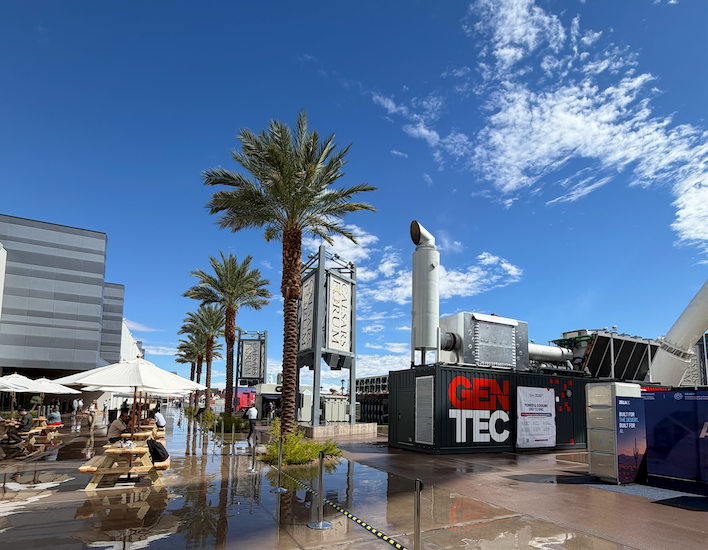
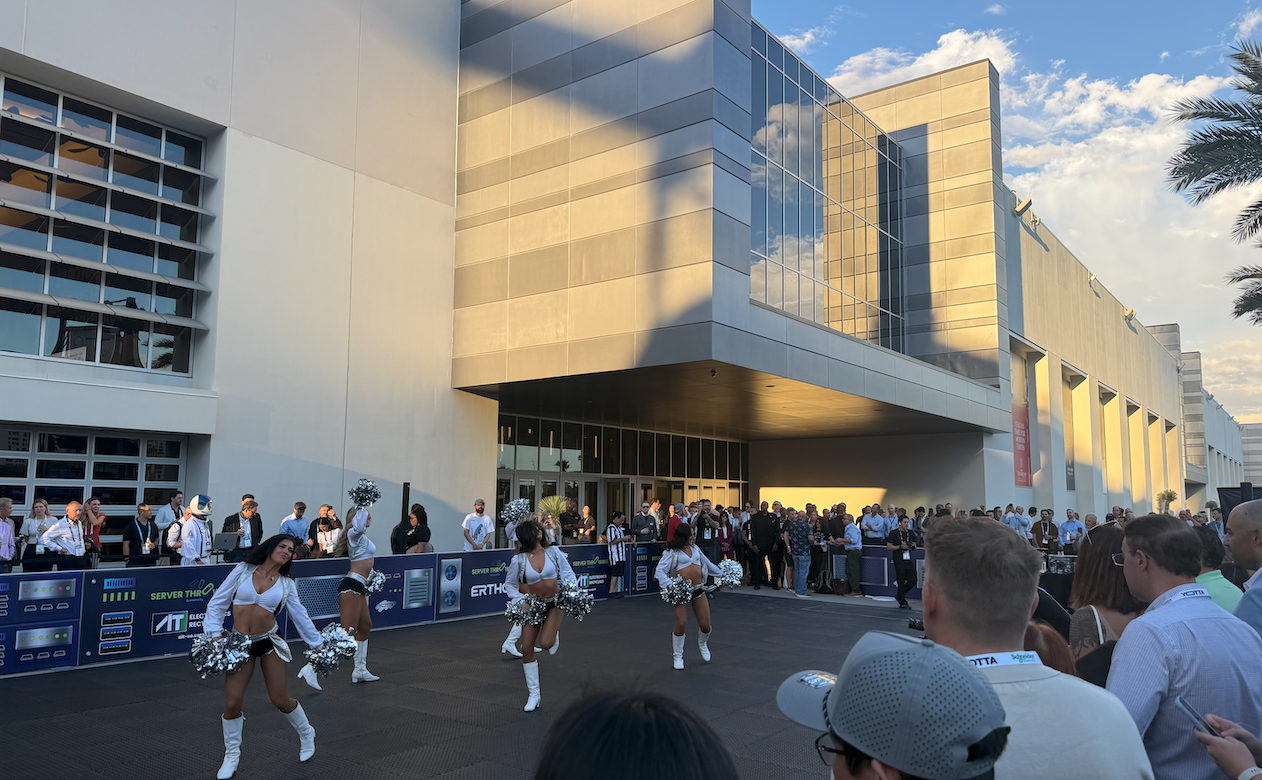
This was at Yotta’s kickoff party under a glowing evening sky and the comically large Ferris wheel outside Caesars Forum. Other contributors to my general unease: 1) $11 trillion, the number lobbed around gleefully all week, the total investment projected across the digital infrastructure value chain through the end of 2029; 2) the shipping container-sized gas gen set in front of the evening’s festivities, which the heavily made-up booth attendant assured passersby could be delivered onsite and firing within a matter of weeks; 3) the tone of the conversations on the expo floor that could only be described as “mercenary.”
I say tongue-in-cheek because the developer I spoke with had in fact worked in renewables for years. His point was that people worry too much. That the same people who were worried about climate change were now busy worrying about AI, and that these fears are overblown. That data centers don’t use as much water as people think. And that the electricity they require, while substantial, is also paying for much of the clean power we’ve added to the grid in recent years.
“Everything,” he said, “is going to be fine.”
That’s when the DJ decided, unaccountably, to play the Imperial March theme from Star Wars and my ushirometasa really set in.
“We recently did a study and the only thing people would hate more than a data center in their backyard,” said Lon Huber, Chief Planning Officer at Xcel, on a panel about speed to power, “is a nuclear waste storage facility.”
The scale and intensity of the popular backlash against data centers made for a stark backdrop to the dealmaking and thought-leader-ing at Yotta. It’s the rare bipartisan issue. The NIMBY, someone remarked, has been replaced by the BANANA: Build Absolutely Nothing Anywhere Near Anything. Dylan Patel, the founder and Chief Analyst of SemiAnalysis put it more colorfully: “If you tell a cute girl in a bar that you work in data centers, she’s going to punch you in the face.”
Emily Goldfield, Head of Strategy at GridCARE, is working on a solution that might make people hate data centers slightly less. It’s based on a somewhat beguiling statistic, oft-discussed in Las Vegas: that the grid operates at less than 40% utilization for much of the year. In other words, the infrastructure built for peak demand on the hottest days of the year is mostly sitting idle, its costs built into your utility bill.
“If you can't solve a problem, make it bigger.”
GridCARE helps accelerate interconnection for data centers by tapping into that unused capacity, simultaneously avoiding additional utility capex and spreading those aforementioned infrastructure costs across more payers. According to a recent whitepaper, connecting a 1GW data center could reduce customer rates by as much as 5%.
“GridCARE is creating what we call qualified firm power,” Goldfield said. “99% of the time you can get firm service from the grid. 1% of the time, we will create a verified, bounded flexibility plan so you know exactly what you need to do for the 40-70 hours a year when you’re not getting firm service.”
That can include systems-level flexibility, like utility-scale VPPs or GETs. It can be on site flexibility, like backup generation or BESS. It can be compute flexibility like Emerald AI or non-compute flexibility like HVAC.
As someone with a solid climate background—Goldfield was an analyst at Rocky Mountain Institute and an advisor to the DOE Office of Clean Energy Demonstrations—she seemed like a good person to test my thesis against, the idea I’d been clinging to at Yotta, that data center demand represents a generational opportunity for grid modernization.
Goldfield referenced a line beloved by RMI founder Amory Lovins: “If you can't solve a problem, make it bigger.”
“Data centers, when built in a thoughtful strategic way, can be grid assets as opposed to grid burdens,” Goldfield said. “And AI growth is incentivizing utilities to change in a way that decarbonization alone doesn't.”
The industry knows it has a problem here. On panel after panel, data center developers grappled with the souring of public opinion in ways both thoughtful and glib. Some speakers blamed a handful of bad actors for much of the damage, especially projects running a gigawatt of portable gas generators on-site.
"Many people in our society feel left behind from this transformational period,” said Maria Pope, CEO of Portland General Electric. “And data centers have become a symbol of that angst.”
Just how big is the backlash? Currence is tracking some 500 moratoria that have sprung up as politicians and community leaders try to get their arms around something the speed and scale of which we have never before experienced as a country, at least in dollar terms.
The intensity—both of interconnection requests and anti-data center sentiment—is reaching break-glass-in-case-of-emergency level. It’s an election year, and such that even the governors who were rabidly pro-data center twelve months ago are calling uncle.
“The first thing you want to do is take at face value people's hesitation and concern for the local character of their community changing,” said Ann Davis Vaughan, a journalist at The Information and author of the forthcoming book, Gigawatt: The Race for Hyperscale AI and the Rise of America’s Digital-Industrial Complex. “That part is real.”
Former FERC Commissioner Allison Clements said she had never seen such strong, bipartisan angst around any issue. Camus CEO Astrid Atkins pointed out that it “probably wasn't a good marketing pitch to tell everybody that AI is going to take all of your jobs.”
“Frontier labs are making $75m per megawatt. The annualized cost of building is about $15m per megawatt.”
Trust, everyone seemed to agree, is low. Vaughan said the industry doesn’t do itself any favors when they claim that a closed-loop cooling system doesn’t use water. It does, it’s just upstream at the thermal power plant—closed-loop requiring more power than other forms of cooling. And chip plants are quite thirsty, too, she added.
She sees the social license question as part of the broader reindustrialization story in rural areas and the Rust Belt. “Communities have been trying sometimes literally a couple of decades to bring employers and economic activity to their location.”
There was a standard package of tax breaks in place to attract low-margin industries and help bring jobs in. When data centers started taking advantage of those incentives, some began to feel they were being overly generous to a wealthy industry.
“Frontier labs are making $75m per megawatt,” Vaughan said. “The annualized cost of building is about $15m per megawatt.”
The size of that margin is part of the reason that the AI buildout is poised to reach 4% of GDP in the next few years. It also makes clear that communities can ask for much more than they have in the past.
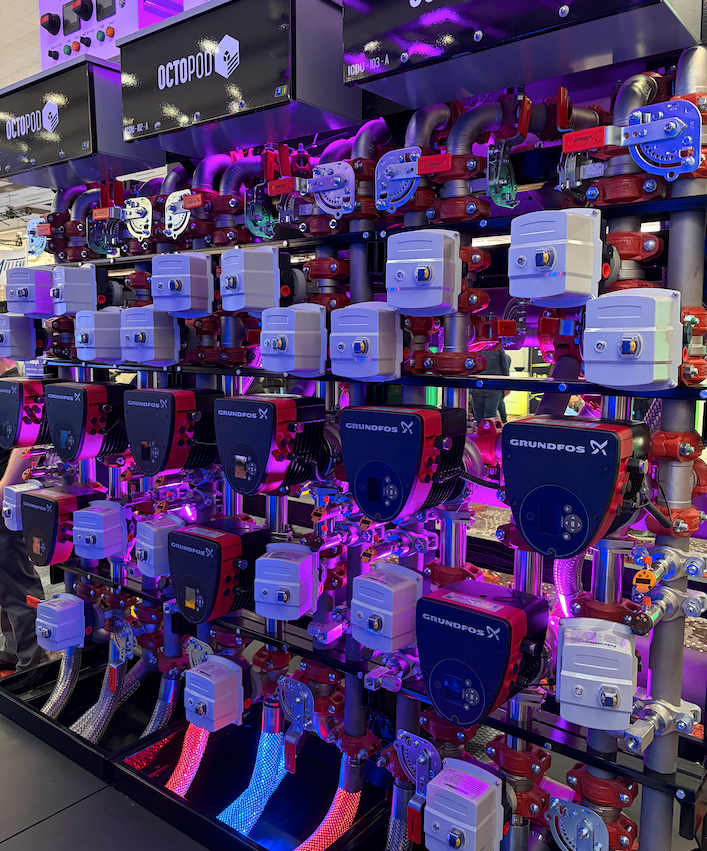
Chris Crosby is the CEO of Compass Datacenters and one of the best known and longest running developers in Texas. He thinks communities need to recognize the leverage they have now, and went on CNBC to say as much. Ask for school budget coverage, new animal shelters, new fire stations, new baseball fields, he suggested, and non-negotiables like adding setbacks, limiting noise pollution, limiting light pollution, limiting water use, and no NDAs.
I tracked Crosby down to ask about the other part of the social license question, my obsession with grid modernization. The grid is ancient in places, 80 years old or more. So what can these flush developers do to build out the grid and harden it against climate risk? How can we harness this moment to create the grid we need for the next century?
“These are the things that we butt our heads against."
“We've already effectively done it on renewables. Because without us there's no solar,” Crosby said. “So why not let us do transmission? If you look at how electricity was built out in the late 1800s, early 1900s, it was public private partnerships. We've got the ability to do that now. But we don't have the laws that allow it.”
This I heard from other attendees as well. Lon Huber said a company approached Xcel and offered to pay for transmission upgrades. Not only could they not accept it, it would take a year and half of regulatory proceedings to change it.
“These are the things that we butt our heads against,” Huber said.
On this topic, Crosby gets animated.
“What if,” Crosby said, “you just let us buy all the land so that the 765 transmission lines could go up and you don't have to use eminent domain. We’ll grant the easements and the lines go up to relieve the grid. The question is how to use capital effectively, because we spend so much effing capital.”
It’s an interesting idea. But even Crosby admits it’s a long shot. Which feeds back into my nagging sense that for all the talk of good grid citizenship and community benefits, the things I’m interested in—flexibility, regulatory innovation, renewable integration, batteries—are at risk of being trampled under the sheer velocity of the gold rush.
By Wednesday, other attendees began to express their own frustrations.
Over a massive pile of scrambled eggs from the buffet, a power plant operator said he couldn’t find anyone who wanted to hook up to the Caterpillar reciprocating turbines he had ordered, even though every panel was talking about how hard it was to find power.
I heard numerous such stories of speculation and the fickleness of the market. Powered land and BTM developers said they were getting lots of interest right up until they were ghosted when it came time to sign on the dotted line. Hyperscalers and neocoulds are looking for maximum optionality. Some of their counterparts on the utility side, the renewables side, and the supplier side perceive a level of wish-washy-ness from the big dogs. It felt there might be more noise than actual contracted demand.
An older gentleman with dyed black hair walking quickly toward the venue at dawn explained to me that he had purchased several parcels of land in Texas, which he felt positioned him well to participate in the data center boom. That said, he didn’t have power yet. Or an offtaker. Or any experience as a developer, apart from the map he built using Grok to visualize data centers and the power lines serving them.
“A lot depends on the midterms,” he said. “If a blue wave happens, it’s going to be our Three Mile Island.” Meaning, it will be devastating for the data center buildout. Even though Democrat and Republican governors alike have been responding to the backlash. Even though it’s only vanishingly likely that such a project will advance to the point where a moratorium would even impact it.
Contributing to the aura of unreality was the 8:30am performance at concert volume of a medley including Michael Jackson’s Beat It and Lil Jon’s Turn Down for What by men in black clothes dancing with the lights off, each of their bodies lit by neon wires.

I began to feel something, not quite hope, maybe something closer to cautious optimism, when I spoke with Jeff Bladen, Head of Energy & Policy at Verrus. Bladen is the former Head of Energy at Meta but also an old-school grid guy, a former Executive Director at MISO who also helped build out the alternative and renewable resource markets subdivision at PJM. (Check out his Volts appearance for the full deep dive.)
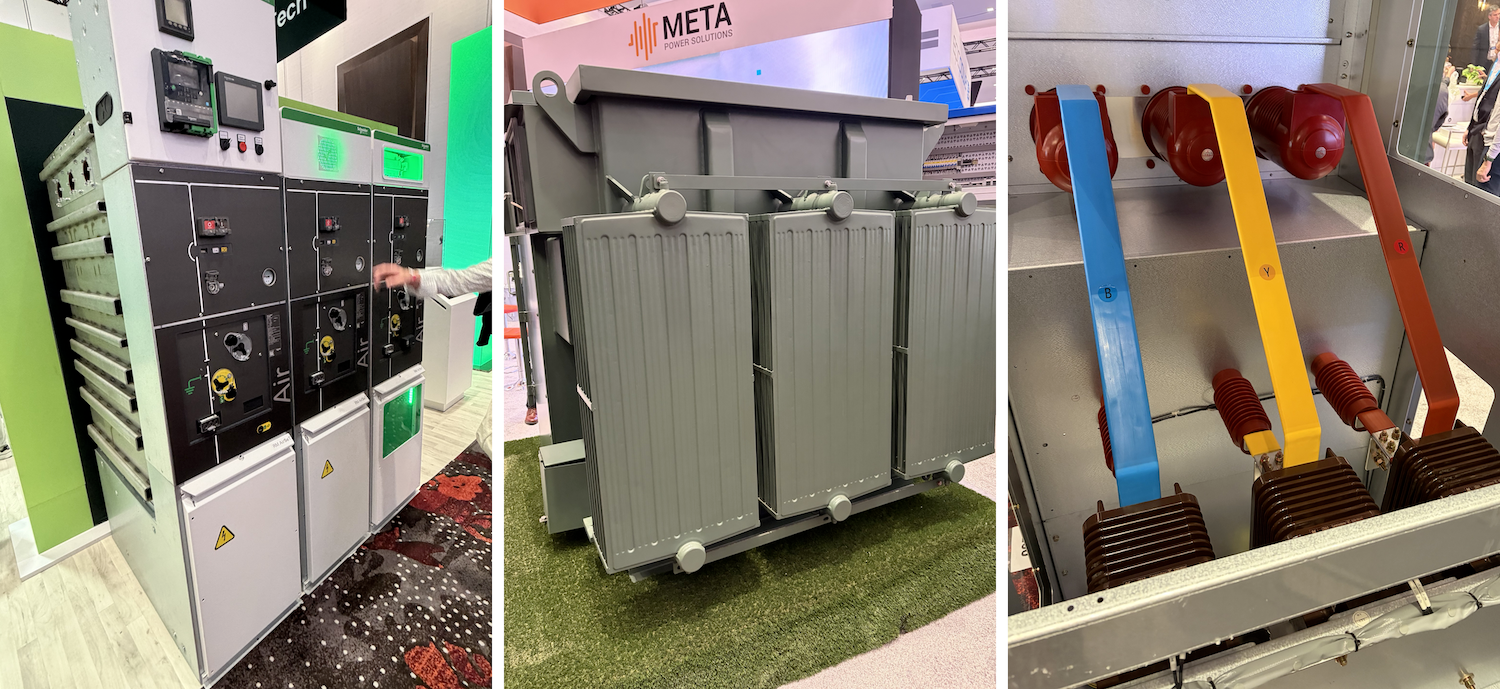
Verrus’s idea is to completely redesign what a data center is from a white sheet of paper. From the power strategy (grid-connected with a MW of utility-scale batteries for every MW of compute), to the power electronics inside the shell (a single mid-voltage power plane and a set of central, software-managed batteries), to the relationship with the community (no more deals in the dark of night).
“It's important to think about data centers as grid assets that use real estate, rather than as real estate that happens to use power,” he told me. “That's the inversion.”
Point number one: Traditionally, a battery on-site is considered a cost center. Verrus turns that around to make it a value creator, unlocking a bunch of potential for grid services. “It's now economically and technically feasible to use battery energy storage as the primary backup, rather than diesel.”
"Think about data centers as grid assets that use real estate, rather than as real estate that happens to use power."
Utility scale BESS allows Verrus to interconnect to the grid while avoiding both new peaking generation and new transmission. That means they can connect faster, which in turn means the customer can start printing money sooner. A matter of months of delay here can quickly reach into the hundreds of billions in lost revenue, a premise repeated so often a Yotta that it took on the quality of an earworm.
Point number two—and here we approach the limit of my engineering faculties—Verrus has redesigned the electrical topology to tap into additional MWhs of compute that remain locked away in legacy designs.
Bear with me: Old school data centers are split up into buildings, data halls, and data rows, each with a dedicated amount of electrical capacity stranded at that row. When the HVAC is running full out, you have the power you need because the wiring supports that peak. But most of the time cooling systems operate at a lower intensity. Servers, likewise, are not running full out, leaving headroom of unused capacity. They reengineered the electrical topology and introduced proprietary dispatch algorithms to allow power sharing across these domains.
Verrus applied the flexibility theme we’re seeing at the grid-level to its internal systems. It’s systems thinking all the way down.
If every data center was built the way Verrus’s are, according to Bladen, we could collectively build one third fewer data centers. If we are to accept the inevitability of this buildout, that is, at the very least, a compelling pitch.
One final thought to leave you with. Because of the aforementioned dollar value of speed to power, some developers claim they are willing to pay almost anything, which explains the trend towards BTM thermal, a solution which entails becoming a power plant operator with requisite skilled labor and engineering complexity. (Chris Crosby: “The arrogance that takes is shocking.”)
That calculation might feel a bit different in five or ten years, when they’re locked in to overpriced energy costs.
No one at Yotta was interested in speculating about the possibility of a bubble. But if there is one, it might be the data centers powered by cheap renewables that survive the downturn.

We asked 100+ climate tech founders how they're raising in 2026. Here's what they said.
Our new report ft. low-carbon data center megadeals, reopened public markets, and rise of adaptation
Get our new report on offtake, with HSBC

 Newsletter