


Happy Monday!
Hope everyone’s staying safe from the wildfire smoke for our East Coast readers, and those near the wildfires across France, Spain, Portugal, and Greece.
Also in Europe, the European Commission just dropped its long-awaited ETS overhaul. We break it down below.
In deals, $30m for nylon recycling in Paris; $20m for rice cultivation decarbonization in Singapore; and $20m for space-grade solar cells in South Korea.
In other news, New York’s data center moratorium, a new proposed law about DOE funding awards, and non-lithium-ion batteries accelerating.
Thanks for reading! Not a subscriber yet?
📩 Submit deals and announcements for the newsletter at [email protected].
💼 Find or share roles on our job board here.
CTVC is powered by Currence, market intelligence to power the AI era.
Wake up, new EU ETS rules just dropped ⏰
Last week, the European Commission announced proposed reforms for the bloc's Emissions Trading System (ETS), the world's first and largest carbon market, after a long-awaited review. It's aiming to ensure the scheme fits with the EU's target of reducing emissions by 90% by 2040, but at the same time is facing competitiveness concerns from European industry about carbon price volatility and energy cost burdens. These new proposals touch on nearly every part of the market and aim to split the difference.
The proposed reforms include:
The EU ETS has been running since 2005, and in that time, emissions in covered sectors have fallen by over 50%. But a lot of the easy low-hanging fruit has been picked. What's left are the sectors and processes where decarbonization is genuinely expensive, technically uncertain, or both. Hard-to-abate industries are, well, hard to abate. Now, the full bill is coming due, and it's arriving in the middle of a crunch. European industry is already squeezed by sky-high domestic energy costs and cheaper offshoring, while defense spending competes for government budgets amid multiple global conflicts.
Although the reforms represent an overall weakening of the cap, they were widely expected given the political pressure. The result is a package that pulls back on some sticks and adds new carrots. For carbon removal developers, BioCCS and DACCS entering the ETS creates a real institutional buyer in Europe, exactly the kind of policy-backed demand signal our recent offtake report found is what actually moves projects. For heavy industry, like steel, cement, and chemicals, the IDB’s new funding and Carbon Contracts for Difference could help underwrite revenue risk. This is good news for hydrogen, as a key enabler for many industrial sectors. A more stable carbon price could also boost hydrogen and ammonia project economics. (Clients can read about this in Currence's Q2 Clean Fuels Outlook).
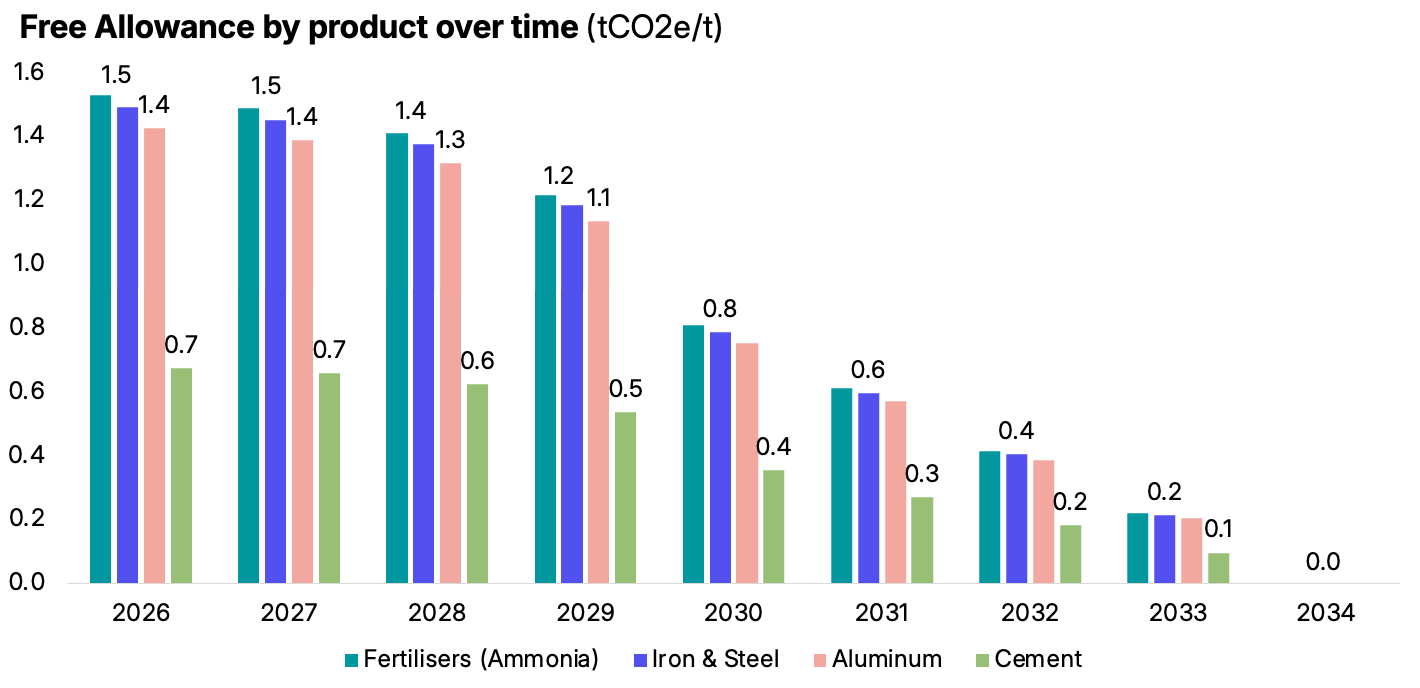
However, slower ramp-downs of free allowances means less pressure on the ammonia industry to decarbonize, pushing offtake agreements and FIDs for blue and green ammonia projects further out.
♻️ Syntetica, a Paris, France-based developer of circular nylon recycling technology, raised $30m in Series A funding from Bpifrance, EQT Ventures, lululemon, MAS Holdings, SWEN Capital Partners, and other investors.
🌾 Rize, a Singapore-based rice cultivation decarbonization platform, raised $20m in Series B funding from BNP Paribas Asset Management, Breakthrough Energy Ventures, Rockefeller Foundation, and Temasek.
💨 Applied Computing, a London, England-based developer of AI for energy operation optimization, raised $20m in Series A funding from KBR and Databricks Ventures.
☀️ FLEXELL SPACE, an Uiwang, South Korea-based developer of space-grade perovskite and copper indium gallium selenide solar cells, raised $20m in Series A funding from IBK Securities, Industrial Bank of Korea, InterVest, Korea Credit Guarantee Fund (신용보증기금), Korea Investment & Securities and other investors.
🏠 NxLite, a Canton, Michigan-based developer of air-stable, energy-efficient, lightweight glass coatings, raised $13m in Series A funding from Crabtree Lane Alt, ACT Venture Partners, Earth Foundry, MUUS Climate Partners, New Climate Ventures (NCV), and other investors.
🏠 Gridcog, a London, England-based energy flexibility modeling platform, raised $10m in Series A funding from ABB, AlbionVC, Axpo, Clean Energy Finance Corporation (CEFC), DNV, and Verbund X Ventures.
🚗 E3 Electric.Ai, a Bengaluru, India-based developer of AI-powered, modular electric scooters, raised $8m in Series A funding from BluVenture Holdings.
🧱 Hyperion Robotics, an Espoo, Finland-based physical AI developer using robotic microfactories to manufacture concrete infrastructure, raised $7m in Seed funding from Course Corrected VC, European Innovation Council (EIC), Lifeline Ventures, PC Rettig & CO Impact, and other investors.
🏗 Visibuilt, a Taastrup, Denmark-based developer of biobased technology for road construction, raised $3.8m in Seed funding from Export and Investment Fund of Denmark (EIFO), Unconventional Ventures, EMD Fonden, and Proptechfonden.
⚡ BiofuelCircle, a Pune, India-based digital biomass supply-chain platform, raised $4m in Series A funding from Spectrum Impact, Better Capital, and Karma Capital Advisors.
🍎 Optiflux, a Houthalen-Helchteren, Belgium-based provider of AI-enabled produce quality management, raised $2.9m in Seed funding from Agri Investment Fund (AIF), Gemma Frisius Fund, LAVA (Logistice en Administratieve VeilingAssociatie), and LRM.
🚗 NextGO Epi, a Berlin, Germany-based developer of Gallium Oxide epitaxial wafers for next-generation power electronics, raised $2.3m in Pre-seed funding from Vireo Ventures, Boris Habets, IBB Ventures, and Ultratech Capital Partners.
📦 BZero Materials, a Valencia, Spain-based developer of compostable thermoplastic starch packaging, raised $1.7m in Seed funding from CTL Investments, Impact Shakers, Ship2B Ventures, Torribas, and Viscofan.
♻️ StratX, a London, England-based developer of landfill covers designed to reduce emissions, raised $1.2m in Seed funding from Neglected Climate Opportunities and CarbonFix.
⚡ Masdar, an Abu Dhabi, United Arab Emirates-based renewable energy and hydrogen developer, raised $2.5bn in PF Debt funding from Abu Dhabi Commercial Bank, Abu Dhabi Islamic Bank, Bank of China, BNP Paribas, Crédit Agricole Corporate and other investors.
⚡ OMV, a Vienna, Austria-based integrated energy, fuels, and chemicals project developer, raised $514m in PF Debt funding from European Investment Bank (EIB).
🏭 TotalEnergies, a Paris, France-based integrated energy supplier, raised $503m in PF Debt funding from an undisclosed investor.
⚡ Positive Zero, a Dubai, United Arab Emirates-based integrated energy transition project developer, raised $375m in PF Debt funding from Natixis Corporate & Investment Banking and The Arab Energy Fund.
⚡ Blueleaf Energy, a Singapore-based developer and manager of renewable energy assets, raised $75m in Debt funding from British International Investment (BII) and Emerging Africa & Asia Infrastructure Fund (EAAIF).
⚡ PureSky Energy, a Denver, Colorado-based community solar and storage project operator, raised $62m in Debt funding from Nomura.
🌾 Rize, a Singapore-based rice cultivation decarbonization platform, raised $11m in Debt funding from BIDV (Bank for Investment and Development of Vietnam), Temasek Foundation, and UOB Venture Management.
🏠 NxLite, a Canton, Michigan-based developer of air-stable, energy-efficient, lightweight glass coatings, raised $3.5m in Debt funding from Regenerative Social Finance (RSF).
🚗 E3 Electric.Ai, a Bengaluru, India-based developer of AI-powered, modular electric scooters, raised $2.6m in Debt funding from BluVenture Holdings.
💨 Carbyon, an Eindhoven, Netherlands-based developer of direct air carbon removal technology, was acquired by Airhive for an undisclosed amount.
🌱 Optera, a Boulder, CO-based sustainability management software provider, was acquired by Green Project Technologies for an undisclosed amount.
This is a sample of deals available for Currence clients. Can’t get enough deals?
🕋 New York just became the first state to ban new hyperscale data centers, for a year. Gov. Kathy Hochul's executive order pauses permits for facilities drawing 50MW or more while the state builds a program requiring data centers to either build their own generation or pay a higher electricity rate, with tougher environmental review to follow. [Link]
A moratorium on new permits does nothing about the projects already in the pipeline. Our own Powerstack ran the numbers when the state legislature passed this bill last month: NYISO's own forecasts put just 2.9GW of the 12.7GW in the interconnection queue as likely to ever get built. So it’s an audit of a queue already full of real estate firms and ex-crypto miners likely to never pour concrete.
🏛️ A proposed OMB rule could let federal agencies cancel DOE awards whenever they want, permanently. The rule would let agencies terminate active, fully-performing awards if they no longer "effectuate agency priorities," with no guaranteed right to appeal; its public comment period closed this week. [Link]
Even if this rule never gets used aggressively, after all the back-and-forth for DOE awardees, this could be dangerous. Especially for founders developing exactly the first-of-a-kind projects the loan programs exist to de-risk.
🔋 In non-lithium ion energy storage news, CATL just shipped its sodium-ion bet to Europe, and Stryten Energy just bought its way into lead-acid. Stryten agreed to acquire C&D Technologies and Trojan Battery Co. [Link, link]
A commitment this size from the world's largest batterymaker is a real signal that sodium-ion’s pushing ahead, and not just in China. And lead-acid consolidation is a reminder about the older tech that’s a backbone for telecom backup and off-grid storage,
⚡ In nuclear news, Holtec filed to go public. Romania's Nuclearelectrica voted to keep betting on SMRs. Shareholders rejected a proposal to reassess the NuScale-based Doicești SMR project or weigh alternative technologies and sites, despite the company's own management warning that financing and FID prerequisites remain unmet. [Link]
Holtec’s filing to go public means the SMR developer joins X-energy and others in a nuclear IPO wave that's testing whether Wall Street will fund first-of-a-kind reactor economics at scale. Meanwhile, NuScale is a useful cautionary case for anyone who wants first-of-a-kind SMR economics on optimistic timelines.
🛢️ BP wrote down roughly $1bn of its low-carbon business in Q2, sitting mainly in gas and low-carbon transition assets that underperformed against traditional oil and gas returns. BP also shut down BP Ventures after nearly 20 years, selling its portfolio of 10+ climate and energy tech startups to Nordic PE firm Verdane for $~1.2bn, about what it had put in since 2006. [Link, link]
It’s the third oil major in two years (Shell, Equinor) to take a clean-energy writedown while raising fossil output guidance, amid the majors’ clean energy retreat.
📈 The Strait of Hormuz is effectively closed again amid new airstrikes. Brent is up nearly 30% from its July lows, with the US naval blockade reinstated and the June ceasefire now effectively dead. [Link]
🛳️ A US firm just went to court over the right to fish uranium out of the ocean, where there's roughly 1,000 times more of it dissolved in seawater than in every known land deposit combined. [Link]
☀️ Google just signed its largest-ever single solar-plus-storage offtake. [Link]
🌱 A take on adaptation tech’s next phase. [Link]
📅 YPE Tour with WindScape Brooklyn: Tour NYC's offshore wind learning center in Sunset Park, hosted by YPE, and see clean energy projects up close, on July 23rd.
📅 Community Climate Innovation Challenge: Idea Lab: Brainstorm and build climate solutions at The Climate Imaginarium in Manhattan, hosted by NYC Data Science for Social Good, on July 25th.
📅 Critical Minerals & Mining Innovation Exchange: Join Campus Deep Tech, the Columbia Lenfest Center for Sustainable Energy, and Pillsbury Law for an evening to explore the next wave of critical minerals, rare earth elements, and mining innovation coming out of world class research labs on July 30th.
📅 Queer Decarbonization Summit: Join LGBTQ+ climate leaders for a curated retreat-conference in nature with leaders from Aligned Climate Capital, Elemental Impact, EDP Renewables, and more. October 6-8, 2026 near NYC.
Head of Revenue, Senior Account Executive @Currence
Director of Data Strategy & Insights @Elemental Impact
Senior Business Development Manager B2B Carbon Markets @Carbonfuture
Lead Data Analyst, Commercial Analytics @Octopus Energy UK
VP, Communications @XPrize
Finance & Ops AI Lead – Associate @Keyframe
Energy & Climate Policy Engagement Lead @Coreweave
📩 Feel free to send us deals, announcements, or anything else at [email protected]. Have a great week ahead!
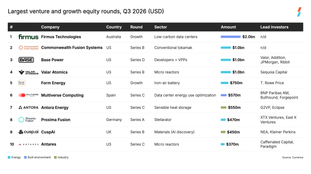
Mega deals took 82% of Q3 dollars as deal count fell to its lowest since 2020
Our Q&A with Fervo COO after Cape Station commercial operation

 Newsletter