Happy Monday!
Our co-founder, Mark Taylor, has covered geothermal since 2007 and never thought he'd see this: enhanced geothermal operating commercially. Yes, the moment we've told clients to watch for years has arrived: Fervo's Cape Station is selling power, the first utility-scale enhanced geothermal plant to do so. We sat down with Fervo's COO below on what comes next, and Currence clients can see where this leaves the sector in our Geo Outlook on the platform.
In deals, $183 for electric two-wheelers in Bengaluru; $175m for solid oxide fuel cells in Eresing; and $134m for low-carbon steel in Texas.
In other news, the cash infusion for advanced steelmaking, SMRs get licensed, and the Senate deals with permitting.
Thanks for reading!
Not a subscriber yet?
📩 Submit deals and announcements for the newsletter at [email protected].
💼 Find or share roles on our job board here.
CTVC is powered by Currence, market intelligence to power the AI era.
Hotter, deeper, faster, cheaper, and now, energized.
Fervo's first commercial power plant, Cape Station in Utah, is officially selling power to the grid. The enhanced geothermal developer has been working toward this moment since June 2023, when it started drilling at the site, fresh off testing the approach at Project Red, its pilot in Nevada.
You probably know this by now, but Fervo’s enhanced geothermal technology drills horizontal wells into hot rock, pumps water through the cracks, and uses the heat that comes back up to run a generator. Its innovation is a horizontal drilling and controlled stimulation approach, borrowed from O&G, that creates these engineered reservoirs that can work in far more places than conventional geothermal, which needs hot water already in place underground. Fervo builds repeatable units that each pair a set of wells with their own power equipment, called GeoBlocks, and Fervo has a strong track record of execution. Locking up land early, setting drilling-speed records, signing offtake agreements with utilities and hyperscalers, and learning. So the next one should go up faster and cost less.
Fervo’s first GeoBlock at Cape Station synced to the grid on September 24 and declared commercial operation on September 30, hitting 33MW of net output, the threshold its PPA requires. That block is one-third of Phase I, about 100MW across three 33MW GeoBlocks. The other two are due by January 1, 2027, and the 400MW Phase II is already under construction for 2028.
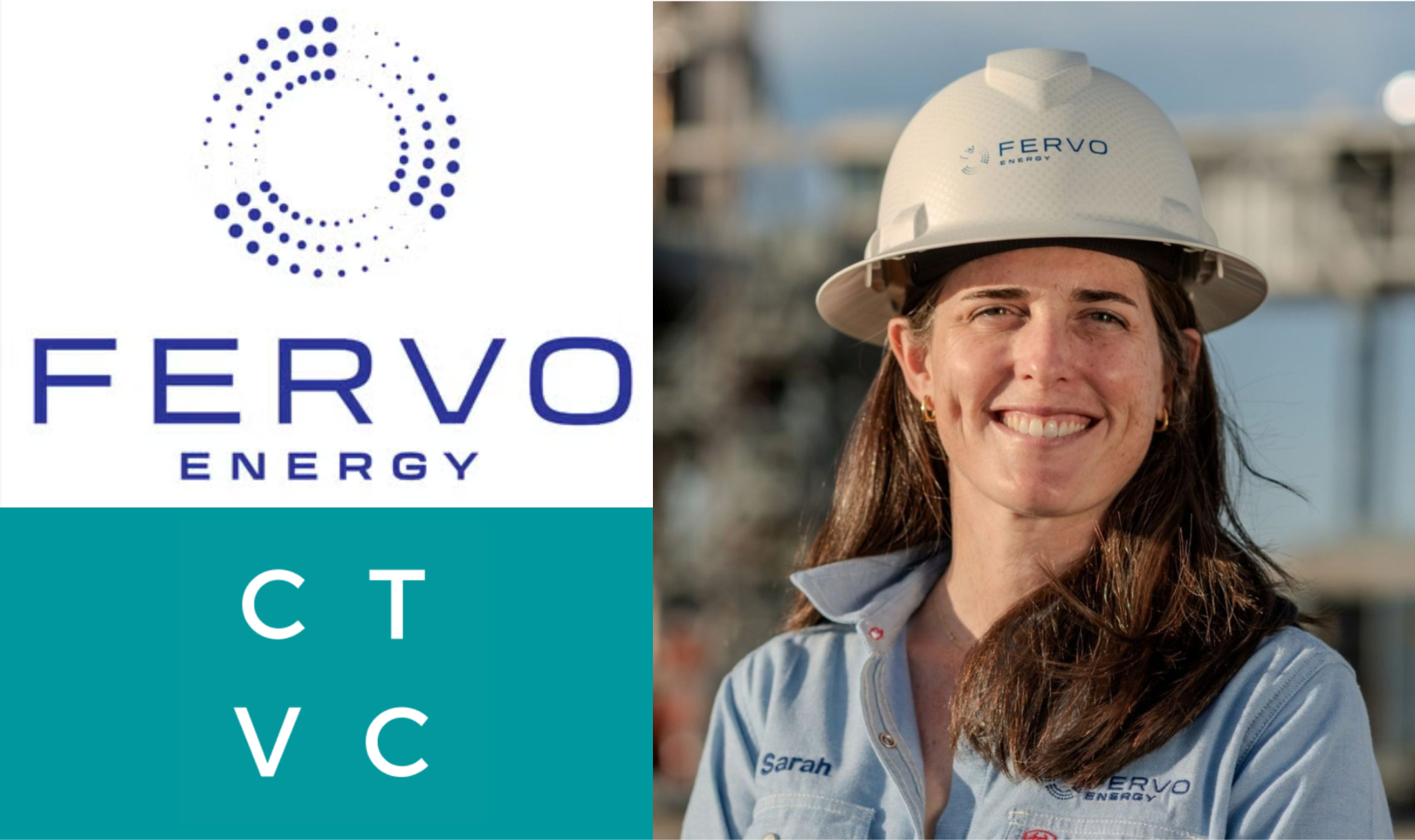
Fervo, already public, is now focused on delivering all of it. So we sat down with Sarah Jewett, Fervo's COO, to talk about this milestone and what comes next.
What does commercial operation change?
"It changes everything, and it changes nothing at all," Jewett said. "We weren't gonna stop if this didn't go perfectly." But Fervo now has "proof of technology and proof of execution," she said. "Many people thought there would be no proof of either."
What comes next at Cape Station?
The first block's power sells to Shell Energy, and the other two (operational by January 1, 2027) are slated for Southern California Edison. That power will count toward a 2021 California Public Utilities Commission order that the state's utilities procure at least 1GW of new firm, zero-emission power.
The 400MW Phase II is progressing as planned, Jewett said: "You can see the power plants going up. You can see rigs drilling wells." The wells drilled so far are more productive than Phase I's. Fervo also announced a 396MW PPA with Google on September 1, the largest enhanced geothermal PPA to date, with first power targeted for 2028 and an option for about 600MW more.
Where are PPA prices heading?
"We quote publicly that we're seeing PPA prices between $100 and $130 a megawatt-hour," she said. "I think $130 is no longer the cap of what we're seeing." Hyperscalers, she added, "still believe they have a lot of options."
[Fervo's S-1 models firm power at $115, and we dug into PPA prices in our sister publication, Powerstack, in May.]
What's the plan for cost and speed?
"We are pursuing a manufacturing model rather than a bespoke infrastructure model," Jewett said. Fervo aims to build a full 50MW GeoBlock, wells and power plant together, in 18 months, and calls $3,000 per kilowatt in overnight capex a "stretch but achievable" target. Canary Media previously reported that Phase I costs about $7,000 per kilowatt and Phase II about $5,500. An independent engineering report says Cape Station's resource could support up to 4GW, she noted.
How are you handling other challenges, like workforce and transmission?
Fervo hires oil and gas crews for the underground work, with no retraining needed. Above ground, labor means pipe fitters, electricians, laborers, and boilermakers. Fervo is building surface trades through an apprenticeship program with Southern Utah University, Jewett said.
On transmission, Fervo runs three tracks: traditional interconnection queues, grid-connected delivery like Phase I's sales to Shell and Edison, and behind-the-meter co-location, which it is exploring with Google at Cape Station. Some states are more open to behind-the-meter setups than others. “We have to have this multipronged approach,” Jewett said.
Water loss and thermal decline are the constant questions about the tech. Where do they stand?
Project Red recovered about 70% of the water it circulated over two years, Jewett said, but that was a single injector and a single producer, so stray water had nowhere to go. Cape Station has many wells per pad, with injectors interspersed among producers, so water leaving an injector "is picked up on all sides." The plants are air-cooled, and Fervo uses brackish groundwater that’s not suitable for agriculture. She said more water-loss data will be published soon now that the plant is operating.
As for thermal decline, "heat is a depletable resource," Jewett said, and wells decline over time. But the drop will come later at Cape than at Project Red, because Fervo now spaces wells farther apart, which sweeps more rock. The solution is also from O&G: "As the resource starts to decline in productivity over time, you drill additional wells." Phase I was financed under scenarios ranging from highly conservative to best case for infill drilling, and she said those later wells will draw on more learnings.
🛵 Simple Energy, a Bengaluru, India-based manufacturer of electric two-wheelers, raised $183m in Series C funding from Arokiaswamy Velumani Family Office, Haran Family Office, and other angel investors.
⚡ Reverion, an Eresing, Germany-based solid oxide fuel cell developer, raised $175m in Series B funding from Kembara, Allianz, Aurum Impact, Carbon Equity, Energy Impact Partners, and other investors.
🏭 Hertha Metals, a Conroe, TX-based low-carbon steel producer, raised $134m in Series A funding from Khosla Ventures, Doerr Capital, US Department of Defense (DoD), Clean Energy Ventures, Gates Foundation, and other investors.
🏠 Efficient Computer, a Pittsburgh, PA-based energy-efficient processor developer, raised $97m in Series B funding from TQ Ventures, Borderless Capital, Eclipse, Giant Ventures, Mana Ventures, and other investors.
⚡ Novele, a Stamford, CT-based developer of AI-enabled energy storage and management systems for commercial buildings, raised $17m in Series A funding from Boisei Labs, Arup Ventures, Barton Malow, and Locke Health.
🐄 Arkea Bio, a Boston, MA-based developer of cow vaccines for enteric emission mitigation, raised $15m in Series A funding from AgriZeroNZ and Breakthrough Energy Ventures.
⚡ Sun King, a Chicago, IL-based off-grid solar company, raised $5m in Growth funding from Acumen.
⚡ Daedal Systems, a Toronto, Canada-based fusion energy plasma measurement technology developer, raised $4m in Seed funding from OMERS Ventures, Garage Capital, MaRs Investment Accelerator Fund, Panache Ventures, and Ripple Ventures.
⚡ NOX Energy, an Antwerp, Belgium-based residential energy flexibility software platform, raised $3m in Seed funding from Volve Capital, Rise PropTech, 100IN, Fair Capital Impact Fund, Seeder Fund, and other investors.
⚡ VoltaBack, a Levallois-Perret, France-based fleet management and EV charging reimbursement software provider, raised $3m in Seed funding from Serena Capital, and angel investors.
⚡ Cotierra, a Zürich, Switzerland-based decentralized biochar reactor and MRV platform developer, raised $3m in Seed funding from Carbon Removal Partners, PINC, Better Ventures, Carbon Drawdown Initiative, GOTA Ventures, and other investors.
⚡ Lydian Energy, a Washington, DC-based utility-scale solar and battery storage independent power producer, raised $300m in Debt funding from Infranity.
⚡ Northland Power, a Toronto, Canada-based independent power producer, raised $130m in PF Debt funding.
🏠 atNorth, a Reykjavík, Iceland-based low-carbon colocation data center provider, closed a PE buyout from Canada Pension Plan Investment Board (CPP Investments), Equinix, and Partners Group at an implied valuation of $4.1bn.
⚡ Vector Renewables, a Madrid, Spain-based provider of renewable energy advisory and asset management services, closed a PE Buyout from Algebris Investments.
⛏️ Searles Valley Minerals Operations Inc., an Overland Park, KS-based brine-based borate and specialty minerals producer, was acquired by 5E Advanced Materials.
🏗️ Zero Infinity Partners, a New York, NY-based early-stage venture capital firm focused on technology across energy, power, mobility, and digital infrastructure, completed a first close of $156m for its second fund, ZIP Fund II.
🥘 Bramble Partners, a London, England-based venture capital firm investing in agritech, completed a first close of $26.4m for Bramble Fund I.
This is a sample of deals available for Currence clients. Can’t get enough deals?
🏭 Washington invests in domestic metal production. Advanced steelmaker Hertha Metals' $134m Series A included $65m from the US government. Mesabi Metallics also unveiled a $15bn Iowa steel mill with Trump, supplied by its Minnesota iron ore mine and pairing gas-based iron purification with an electric arc furnace. Meanwhile, Stegra, Europe's green steel flagship, is running out of money, days after announcing a Google offtake. [Link, Link, Link, Link]
The Pentagon is taking equity in domestic metals production to boost the supply of rare earth magnets. This is one way the administration is funding things the IRA used to. For this White House, the framing is national security, not emissions. Meanwhile, for Stegra, the first-of-a-kind green plant completion costs are "significantly higher than assumed."
☢️ Big week in conventional and advanced nuclear. The NRC issued only its second advanced-reactor construction permit, for the first US BWRX-300 at TVA's 300MW Clinch River project, six months after TerraPower's. Amazon signed a 20-year deal for 690MW from Constellation's Calvert Cliffs plant in Maryland that makes a 190MW uprate possible. [Link, Link]
The NRC issued the permit in under 14 months, so Clinch River is becoming the licensing template. TVA hasn't announced a cost or start date, though. On the other side, upgrading existing plants are the fastest, cheapest MWs around, which is why Google and Amazon are paying for them.
🏛 The Senate’s been busy on permitting and data centers. Senate negotiators reached a bipartisan permitting deal, though Heinrich and Whitehouse are still withholding endorsements. Senate Democrats are also gearing up to tank data center legislation that passed the House overwhelmingly, arguing it doesn't go far enough to protect consumers from rising power prices. [Link, Link]
If the permitting bill text holds, it will speed up the interconnection process and change the wait times for developers across the country. But the data center backlash and affordability are putting a lot of pressure on Washington.
💨 Texas greenlit ExxonMobil's 53m ton Rose CCS site with Class VI wells, while INEOS opened the EU's first full-scale CO2 storage site in the Danish North Sea. [Link, Link]
Class VI means dedicated sequestration wells, not just for enhanced oil recovery, so a big deal for CCS and storage rather than boosting yield. INEOS also turned on the first EU commercial-scale site the same week.
🚀 In space news, SpaceX's Starship deployed satellites in orbit for the first time, Google announced its first AI data center bound for space, and Virtus Solis signed a 20-year, 100MW PPA with data center developer Brae Systems for power beamed from a satellite. [Link, Link, Link]
The vending-machine satellite video is worth a watch, though the vehicle exploded on landing, so it can't be reused. For the PPA, while derisked demand is real progress, wireless power transmission, orbital panels, and enforcing a contract in space are all still very much unknown.
🌍 EU emissions are declining too slowly to hit 2030 targets, falling 2% in H1 2026, a pace that would reach the 2030 goal by 2034. [Link]
The biggest drop came from industry and buildings, with a 10.8% cut in oil emissions driven mostly by Strait of Hormuz supply disruption. That could reverse as prices ease and buyers restock. Wind and solar beat coal in H1, and gas was the only fossil fuel whose emissions grew.
⛽ Diesel and jet fuel prices hit record highs, with US diesel at $5/gallon. [Link, Link]
✈️ SAF supply exceeded the first year of the EU mandate, with a 93% compliance rate among obligated airlines, per EASA. [Link]
☀️ California greenlit balcony solar alongside other new laws aimed at benefiting utility ratepayers. [Link]
🧱 LEGO began using green hydrogen-based methanol in toy production. [Link]
💡 Heatmap covered a new Sustainable AI Group dashboard ranking how much energy each proprietary AI model burns. [Link]
📅 Battery Energy Storage System: A free virtual workshop by IREC and SEAC on BESS permitting for building/fire departments, installers, and manufacturers, including UL 9540/9540A standards. Oct 7, 12pm ET.
📅 Product-Market-Earth Fit Masterclass: Rewiring User Habits: This session shows product teams how choice architecture and behavioral design can influence downstream emissions, using the E-A-R-T-H model and the Ship-Shape-Shift systems thinking tool. Join Oct 9, 12pm ET.
📅 SF Blue Tech Happy Hour: Maritime Submersibles and Autonomous Systems: During SF Tech Week, join oceantech investors and founders, plus a demo from ocean robotics startup Ulysses. At South Beach Yacht Club in San Francisco, Oct 6, 5:30pm PT, $20.
Account Executive @Currence
Data Product Manager @Currence
Founding Customer Success Manager @Currence
Senior Backend Engineer (AI) @Currence
Director of Growth & Giving @Elemental Impact
📩 Feel free to send us deals, announcements, or anything else at [email protected]. Have a great week ahead!

 Newsletter