


Happy Monday!
The DOE's loan office has a new name, a new mandate, and a new strategic plan through 2030. Here's what changed and where the money's going.
In other news, Massachusetts became the first state to require new data centers to bring their own clean power, China paused approvals of new battery storage plants to curb oversupply, and X-energy's SMR IPO popped 25% on debut as Holtec filed to raise upwards of $1bn.
In deals, $50m for a floating SMR in California; $23m for electric motorbikes and battery-swapping in Kenya; and $10m for EV and CNG fleet management in India.
And Climate Week officially kicks off in NYC Saturday! Lock in your last RSVPs with our guide here.

Thanks for reading! Not a subscriber yet?
📩 Submit deals and announcements for the newsletter at [email protected].
💼 Find or share roles on our job board here.
CTVC is powered by Currence, market intelligence to power the AI era.
The Trump administration rebranded the Department of Energy Loan Programs Office (LPO) as the Office of Energy Dominance Financing (EDF) last year. Now, the agency has just published its first strategic plan for 2026–2030. We went through all 13 pages so you don’t have to - here's what's new, what's gone, and who's getting the money.
What happened
Nothing in the plan is new in itself. But it’s the first time that the rebranded office has laid out a grand unified theory for the money it still controls.
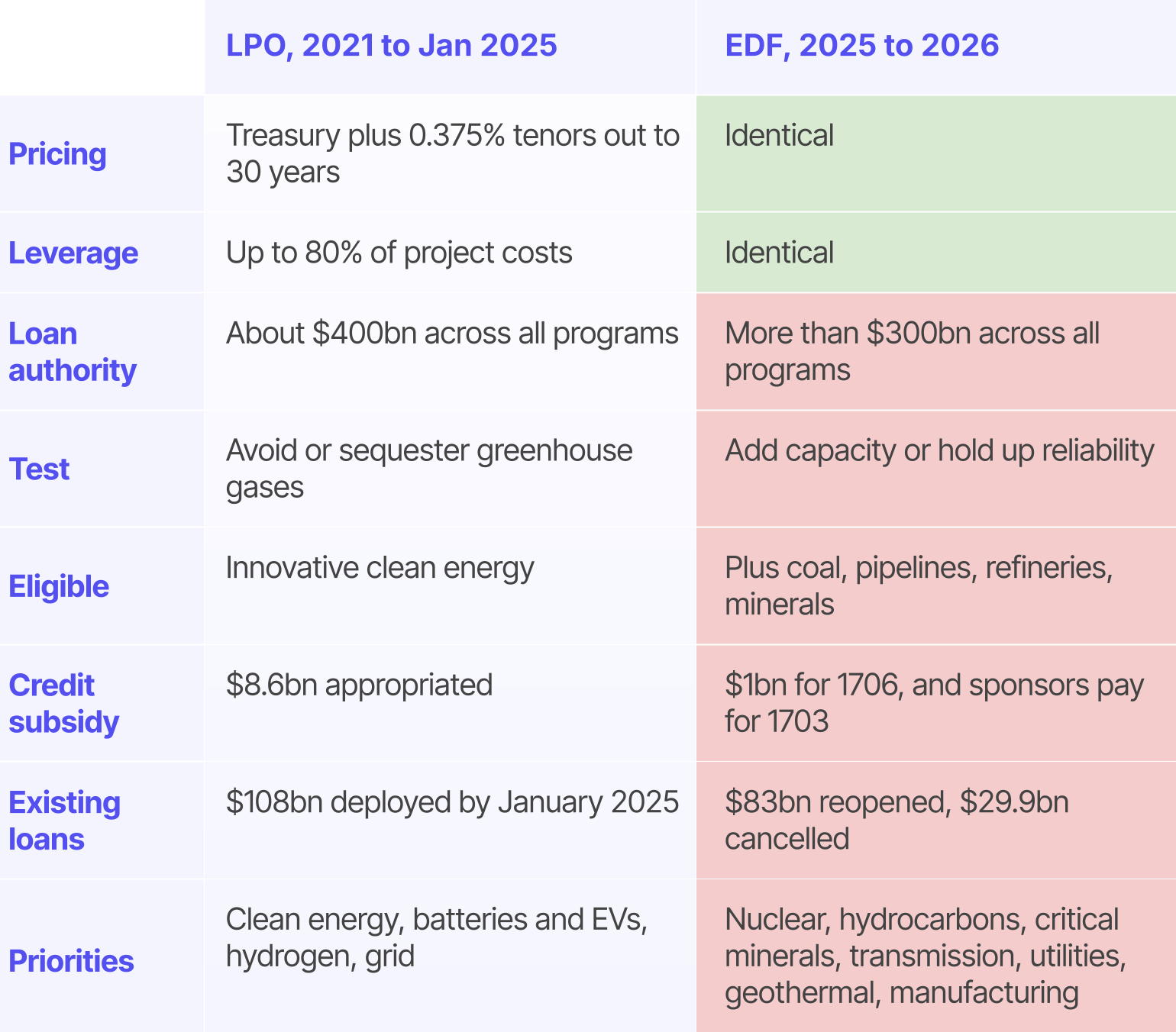
Some background. The office lends through two doors. Section 1703, created in 2005, backs technology too new for commercial banks. It was mostly dormant until the IRA gave it $40bn to lend and $3.6bn to cover expected losses. Section 1706, created by the IRA in 2022, funds retooling, repowering, or replacing existing energy infrastructure, and got $250bn and $5bn. Both doors were set to shut on 30 September 2026. The OBBBA extended 1706 to 2028 and backed its $250bn with $1bn in credit subsidy, but left 1703 to expire and rescinded what remained of the $3.6bn.
The plan also lays out the new priorities - it ties the office's authority to Trump's energy-related executive orders, chiefly Unleashing American Energy and the three nuclear orders from May 2025. It sets five goals, which are familiar but rebranded, and priority sectors, most of which were already eligible, but adds hydrocarbons (read: fossil fuels). The glaring omission is any requirement that projects reduce emissions.
What's new 📈
What's gone 📉
Who's getting the money 🤑
Why it matters
It was an open question after Trump’s election if this office would survive. The LPO is famous in climate tech circles for lending where private banks wouldn't. It backed big names in the space early, from Tesla ($465m in 2010, repaid three years later), to Solyndra ($535m in 2009, lost nearly all of it). But more than that, a conditional commitment from the US government told offtakers, suppliers, and private lenders that the diligence was done, which is how first-of-a-kind projects crossed the Valley of Death.
The EDF isn't doing that. Its reframe is for reliability, cost, and national security, which means capacity projects that align with the administration's goals of, well, energy dominance. Nuclear, geothermal, storage, transmission, and minerals processing all still qualify.
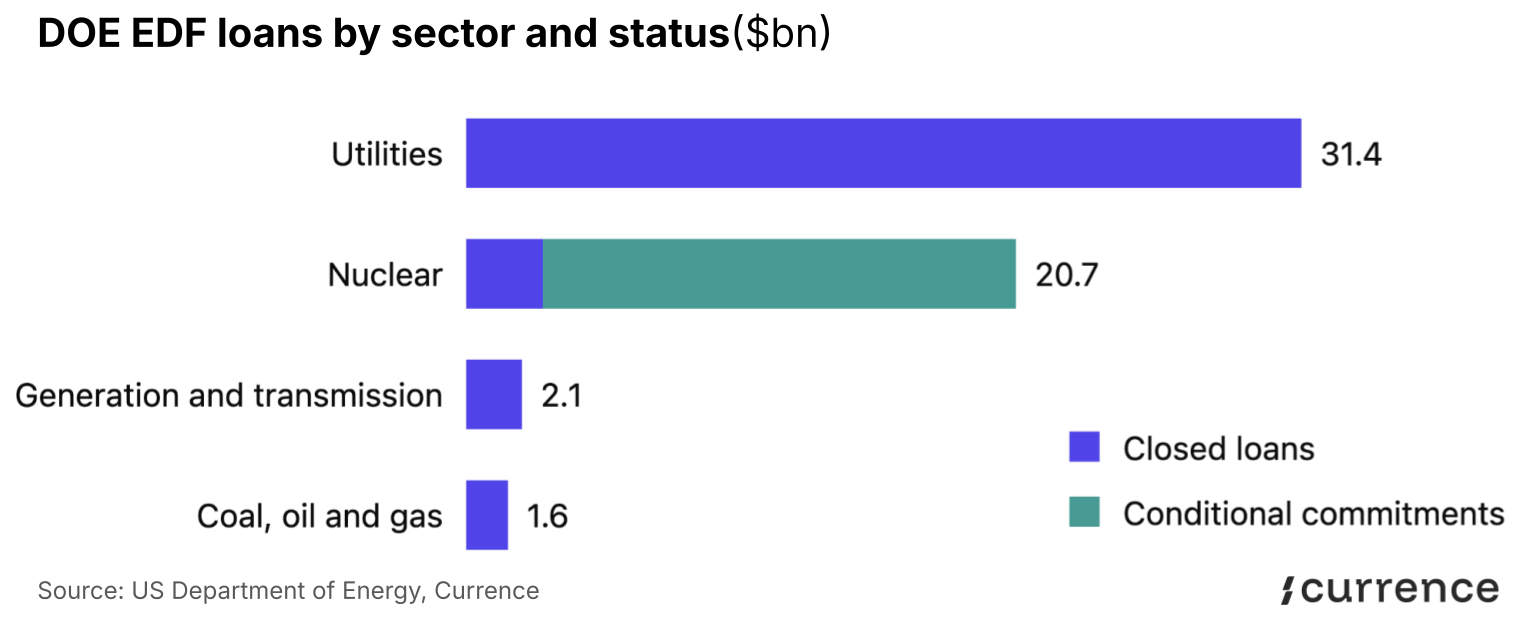
Adding capacity and holding down bills isn't a bad use of federal debt. But it isn't catalytic either, for emerging technologies or for reducing emissions. Most EDF awardees aren’t facing the same risk as LPO ones. Southern and AEP are large regulated utilities that recover their costs through rates, and the guidance requires utility borrowers to pass the savings to customers, part of how those deals qualify in the first place.
Key takeaways
⚡ Bluecore Energy, a Long Beach, CA-based developer of floating small nuclear reactors, raised $50m in Seed funding from Silverton Partners, Collab Capital, Harlem Capital, HartBeat Ventures, and Slauson & Co.
🚗 ARC Ride, a Nairobi, Kenya-based electric motorcycle and battery-swapping platform, raised $23m in Series A funding from Norrsken22, Novastar Ventures, British International Investment (BII), International Finance Corporation (IFC), and Proparco.
🚗 Carrum Mobility, a Gurgaon, India-based EV/CNG vehicle fleet management platform, raised $10m in Series B funding from Uber.
⚡ Molten Salt Solutions, a Santa Fe, New Mexico-based developer of isotopically enriched lithium, raised $7m in seed funding from Dolby Family Ventures, Alumni Ventures, Future Ventures, Gaingels, True Ventures, and other investors.
♻️ Jaipur Robotics, a Lugano, Switzerland-based AI-powered waste facility automation developer, raised $5.0m in Seed funding from EquityPitcher Ventures and High-Tech Gründerfonds (HTGF).
🔋 Rebaba, a Stockholm, Sweden-based second-life battery storage systems provider, raised $4.6m in Seed funding from SISTAFUND and EIT Urban Mobility.
🏠 Circolife, a Mumbai, India-based subscription-based cooling services provider, raised $4.3m in Seed funding from INTELLIQUITY VENTURES, Param Capital, Sky Impact Capital, and Vyom Wealth, and angel investors.
⚡ FRYTE Mobility, a Munich, Germany-based electric truck fleet management platform, raised $4.1m in Seed funding from 4impact Capital, Rethink Ventures, Accilium Ventures, F-Log Ventures, and Revent.
☔ Veridue AI, a London, UK-based AI-powered energy investment due diligence platform, raised $4.0m in Pre-seed funding from Episode 1 Ventures, High-Tech Gründerfonds (HTGF), and Pi Labs.
💧 DigitalPaani, a Gurgaon, India-based IoT-enabled water and wastewater management platform, raised $2.3m in Seed funding from Navam Capital, 3one4 Capital, AWE Funds, Chakra Growth Capital, Echo River Capital, and other investors.
⚡ Elia Transmission Belgium, a Brussels, Belgium-based electricity transmission operator, raised $1.2bn in PF Debt funding from European Investment Bank (EIB).
⚡ Aukera Energy, a Brussels, Belgium-based pan-European renewable energy and battery storage developer, raised $535m in Debt funding from EIG Global Energy Partners (EIG).
🚗 ARC Ride, a Nairobi, Kenya-based electric motorcycle and battery-swapping platform, raised $10m in Debt funding from British International Investment (BII) and Mirova.
⚡ Anesco, a Reading, England-based renewable energy, energy efficiency developer, raised an undisclosed amount in PF Debt funding from Lombard.
🌱 Normative, a Toronto, Canada-based corporate carbon accounting platform, was acquired by Greenly at an implied valuation of $75m.
♻️ Siltworm, a Saint John, IN-based erosion and sediment control products provider, was acquired by MKB Company for an undisclosed amount.
⚡ Green Eagle Solutions, a Madrid, Spain-based renewable energy SaaS solutions provider, closed a PE Buyout from Copilot Capital.
⚡ ENERPARC AG, a Hamburg, Germany-based large-scale solar power developer, filed for Bankruptcy.
Molten Ventures, a London, UK-based venture capital firm investing in Series B and later-stage European tech companies across space, AI, fintech, quantum computing, and deep tech, announced the first close of $175m in its Growth Fund.
This is a sample of deals available for Currence clients. Can’t get enough deals?
☢️ Big nuclear week: a restart and an extension. DOE closed a $1.9bn loan to restart Duane Arnold, while Google committed €13bn to Finland and signed its first nuclear PPA outside the US, a 22-year contract with Fortum for half of Loviisa's output from 2030 to 2049. [Link, Link]
Two countries financing already built nuclear: in the US the DOE restarts a plant, in Finland a 22-year private contract underwrites a life extension on a running one. Both are betting that the most efficient MW of nuclear is the one already built. Fortum is putting roughly €1bn into extending Loviisa's two VVER-440 units to 2050, with a 38MW uprate in 2028. Google is not the only buyer of Finnish nuclear, so are Meta, Microsoft, Nebius, DayOne and QTS.
🔔 Nuclear's public market run continues. X-energy's SMR IPO popped 25% on debut, Holtec filed to raise upwards of $1bn on Nasdaq at a roughly $10bn valuation, and fusion developer Shine lined up bankers. [Link, Link]
Wall Street has decided advanced nuclear is investable at scale, or at least, want the liquidity. The looming question is whether the plants show up on schedule and the performance afterwards.
🏛 Massachusetts became the first state to require data centers to bring their own clean power. The Healey administration issued rules requiring new data centers to generate clean energy on-site and sign community benefits agreements. [Link, Link]
New York paused permits, Texas paused grid connections, and Massachusetts is the first to attach clean (!) conditions, instead of a moratorium.
📈 Global coal consumption is tracking toward a 1.2% rise this year to a record 8.94bn metric tons, per the IEA, even as the US solar industry added 11.4GW in Q2, a 45% year-over-year increase. [Link]
Both records show just how fast global power demand is surging. While Solar keeps compounding, demand growth outruns it. This is the same pattern the EIA found in US power sector emissions in July.
✈️ SAF takes off in Australia: Jet Zero Australia closed a $30m Series C, and UK-based Carbon Neutral Fuels signed an MoU with Energy Estate for a sugarcane waste-to-SAF project in Queensland. [Link, Link]
An underexplored market with abundant waste feedstocks, but the policy stack isn't there yet. Cheap electricity promises are drawing eSAF interest too, though the grid is already stressed and multiple Australian green hydrogen projects have died on power prices, connection costs, and missing demand.
🇰🇷 South Korean researchers turned 18.7 tons of kimchi radish waste into bioplastics. [Link]
🔋 China paused approvals of new battery storage manufacturing plants to curb domestic oversupply, a rare reversal after years of aggressive capacity expansion. [Link]
🚢 The IMO makes its call on shipping carbon pricing in December. At a recent working group, 38 countries spoke in support of the Net Zero framework and 17 against, with the next technical session at the end of November. [Link]
🐑 Switzerland is putting sheep's wool on a melting glacier. The "Keep It Wool" experiment on the Tsanfleuron Glacier tests whether natural fiber can replace the synthetic sheets used for years to slow summer melt. [Link]
🌡️ Last month was the hottest August globally since record-keeping began, tying with July 2023 for the warmest of any month. [Link]
💡Battery Report 2026 - Contributor Application: Contributors are the backbone of the Battery Report: bringing industry expertise, diverse perspectives, and plenty of spirited discussion to each chapter. It's a great way to help shape this year's Report and collaborate with other battery professionals. Contribute by 11:59PM PST September 16th.
📅Greentown Labs Climatetech Summit: Greentown opens its Houston incubator for its annual gathering of founders, investors, corporates, and policymakers, with startup showcases and industry panels on the energy transformation. At Greentown Houston on September 16.
📅 Climate Week NYC 2026: 1,000+ events across the city alongside the UNGA, with the Opening Ceremony September 21. Join thousands at the biggest climate week in the nation to celebrate success stories and continue pushing the needle on sustainability. September 20–27, New York City. Check out our guide here.
💡 Google Carbon Removal and Superpollutant Elimination R&D Awards: Unrestricted research funding of up to $500K per project for work on carbon dioxide removal and high-impact climate pollutants (methane, N₂O, F-gases). Open to businesses focussed on advancing research or innovation; funds disbursed by year-end. Apply by September 25.
💡 Climate Resilience Awards for Business 2026: WBCSD and the Global Resilience Partnership's awards recognizing measurable adaptation and resilience action. Open to companies of any size and geography. Apply by September 30.
US Enterprise Sales Director @Eztia
Founding Customer Success Manager, Marketing Intern, Senior Account Executive @Currence
Investor, Early Stage Team @Lowercarbon Capital
Program Director, Superhot Rock Geothermal @CATF
Founding Chief Technology Officer @Telluscope
Director of Growth & Giving @Elemental Impact
📩 Feel free to send us deals, announcements, or anything else at [email protected]. Have a great week ahead!
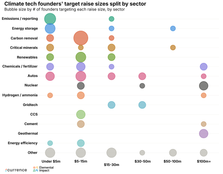
CTVC and Elemental Impact surveyed 100+ founders. This is what they said
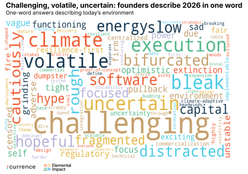
We asked 100+ climate tech founders how they're raising in 2026. Here's what they said.

 Newsletter